
Slow Theology by A.J. Swoboda & Vijay Gupta — A Christian Book Review on Resilient Faith

Why I’m Sharing Book Reviews Here
This Christian book review is part of my ongoing rhythm of slowing down with thoughtful theology and spiritual formation resources. I share honest, reflective reviews for readers who are seeking a resilient, steadfast relationship with God.
As part of the Baker Books Review Program, I periodically receive books to read and review. These reflections are written with care, depth, and transparency to help you discern whether a book aligns with your season of faith.
(Disclosure: I received a complimentary copy of this book from Baker Books. All opinions are my own.)
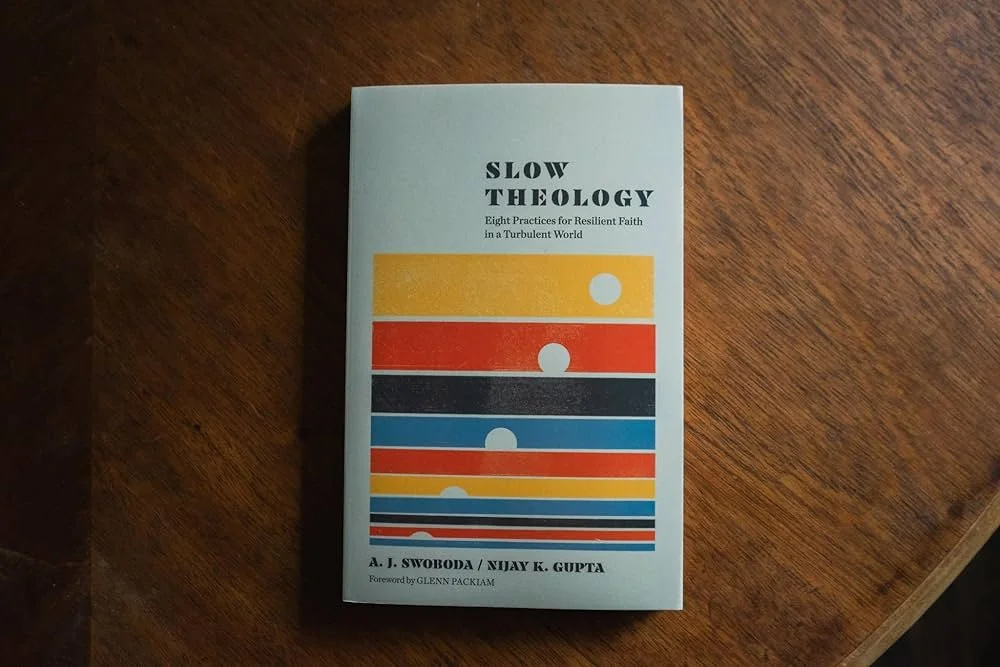
Book at a Glance
Title: Slow Theology: 8 Practices for Resilient Faith in a Turbulent World
Authors: A.J. Swoboda & Vijay Gupta
Publisher: Baker Books
Genre: Christian Living / Spiritual Formation / Theology
Best For: Readers seeking a slower, deeper, and more resilient Christian faith
Summary: What Slow Theology Is About
At its core, Slow Theology is an invitation to resist speed and shallow certainty in our faith.
Swoboda and Gupta argue that much of modern Christianity has been shaped more by urgency and productivity than by wisdom and love. Instead, they invite readers into eight historic Christian practices that form a faith capable of withstanding cultural upheaval, doubt, suffering, and change.
This isn’t theology as abstraction. It’s theology that represents a journey.
Key Themes and Takeaways
Rather than shaming readers for burnout or shallow faith, the authors speak with gentleness and gravity. There’s a shared sense throughout the book that: You’re not broken for feeling exhausted by faith. You’re human.
Several practices stood out to me personally:
The emphasis on patience and formation over immediacy
The reclaiming of theology as something practiced, not just believed
The integration of community, suffering, and embodiment as theological teachers
As someone who often teaches seekers and those recovering from church hurt, I found this approach both pastorally sensitive and spiritually grounding.
Personal Reflection: Reading Slow Theology in This Season
This book landed in a season where my faith has felt more like relearning how to stay.
Slow Theology gave me language for something I’ve been experiencing but hadn’t fully named: the need for a faith that doesn’t rush and doesn’t confuse loudness with depth.
It reminded me that slowness isn’t disengagement—it’s devotion.
Who Should Read Slow Theology
I’d especially recommend Slow Theology if you:
feel spiritually exhausted or disillusioned
long for practices that sustain faith over decades, not just seasons
want theology that feels lived-in rather than theoretical
This is not a book for quick fixes. It’s a book for people willing to stay, listen, and be formed.
Final Verdict: Is Slow Theology Worth Reading?
Slow Theology offers something better: a way of being faithful in a fast-paced world.
If you’re craving a faith that can breathe, bend, and endure, this book is well worth your time.
Have you read this book—or are you curious about it? I’d love to hear what resonated with you.